
michael@yupurong.com
+8619257568267
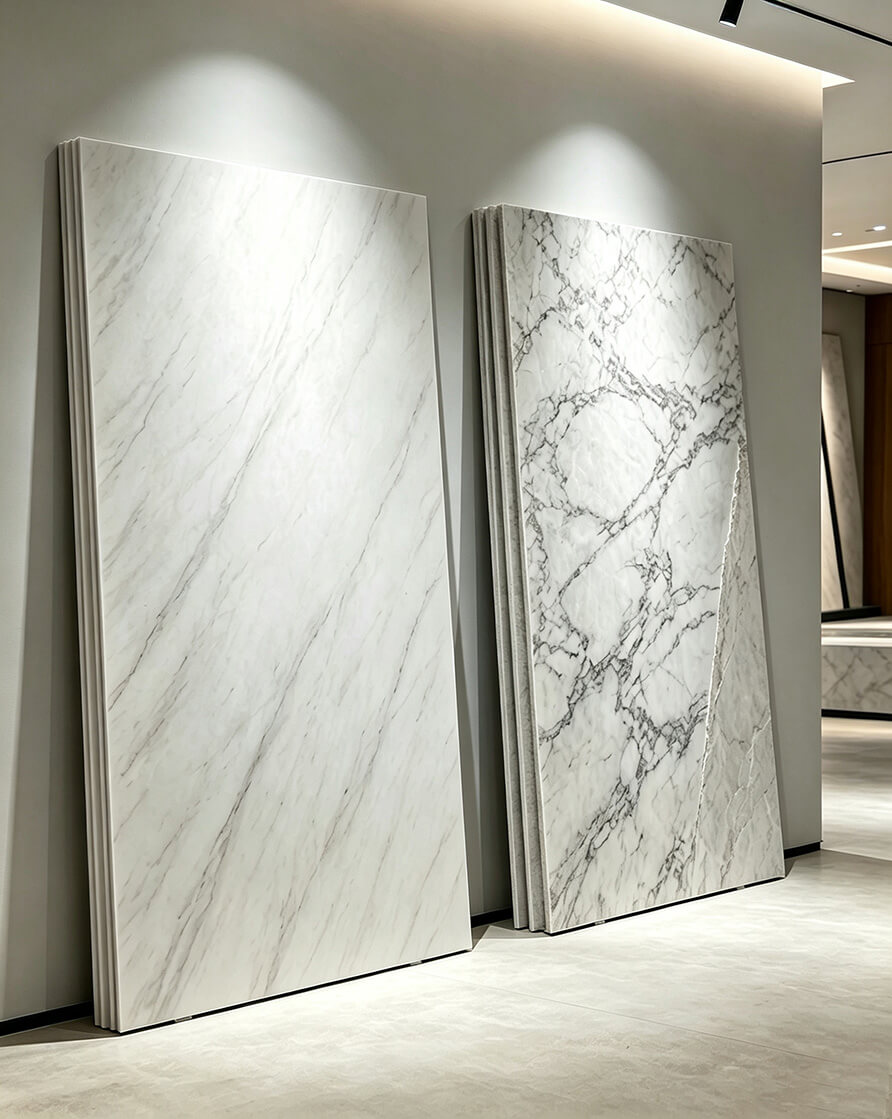
Choosing finishing materials for high-end commercial projects goes far beyond aesthetic preference. On-site installation across multi-storey structures, corner transitions, and phased batch deliveries often yield results vastly different from small sample boards, making the choice between thin porcelain panels and natural stone a vital technical and commercial decision. Both materials fit premium specification requirements for luxury residences, hotels, retail spaces and commercial workplaces. The best option is determined by design intent, substrate conditions, on-site installation capabilities, logistical arrangements and long-term supply stability.
For importers, building material distributors and project procurement teams, the core evaluation standard is clear: identifying the material that delivers stable, high-quality finishing results, supports hassle-free installation and replaceability, and maintains consistent supply to safeguard project timelines and profit margins.
Natural stone is a naturally formed geological material with unavoidable batch differences. Vein patterns, base colours, porosity and mineral composition vary greatly between quarry blocks and individual slabs. This exclusive organic texture is why architects favour marble, travertine, limestone and granite for projects that pursue authentic, one-of-a-kind natural aesthetics.
Thin porcelain panels are high-precision engineered fired ceramic materials, represented by YUPURONG’s mainstream 1000×3000×4.5mm large-format specification. Featuring a ultra-slim profile compared with traditional stone slabs, these panels create seamless, continuous surfaces for wall cladding and furniture finishing. Supported by digital inkjet printing and standardized production processes, they stably replicate premium marble and natural stone textures with reliable batch repeatability.
exclusive natural aesthetics or stable, uniform premium finishing systems.There is no absolute superior material between the two. Natural stone delivers unmatched exclusive natural texture, while thin porcelain features controllable visual effects, ultra-thin lightweight structure and stable batch consistency — perfectly suited for large-scale, multi-scene commercial projects. Material specification should strictly match project positioning and practical demands.
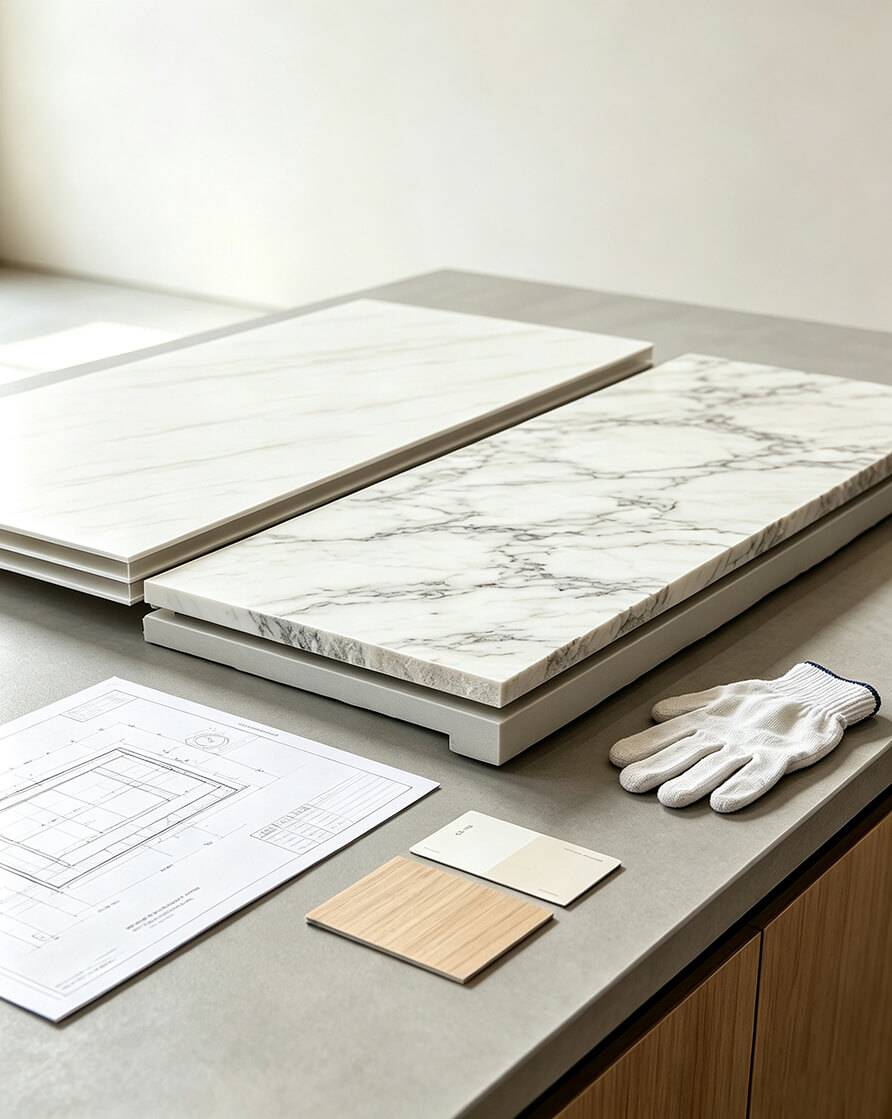
Material weight dictates far more than freight costs. It affects lifting equipment, labour allocation, building floor loads, hoist access, packaging standards, breakage rates and internal material transit in operational buildings.
Natural stone slabs are heavy and require rigorous handling throughout the supply chain. It remains ideal for feature applications including reception counters, luxury bathroom details and accent walls. However, large-scale usage on full wall cladding, elevator interiors, retail columns and renovation sites with limited access drastically increases logistical complexity and labour costs.
Ultra-thin porcelain panels reduce overall finish system load, a key advantage for refurbishment projects with structural and access limitations. While large-format porcelain requires professional installation with standard lifting tools, precise cutting and certified adhesives, it eliminates the excessive handling costs associated with natural stone.
Buyers must evaluate total installed cost instead of unit price alone. Full costing should cover crating, container utilisation, local transport, material wastage, substrate preparation, installation efficiency and replacement expenses. Lightweight, consistent porcelain often delivers better long-term value on complex site projects.
Natural stone features unique depth, subtle translucency and irregular veining that create luxurious, organic finishes. Yet its natural variation creates approval challenges for multi-site brand projects requiring unified vein direction, background tone and visual intensity across spaces.
Thin porcelain gives designers full control over pattern repetition, book-matching, colour coordination and scaling. Large panel sizes minimise grout joints, delivering a sleek, monolithic finish for walls, furniture cladding and select floor surfaces. Designed to replicate premium stone aesthetics, porcelain excels at consistent, scalable visual branding across entire project portfolios.
For distributors, stone-look porcelain serves as a differentiated design solution, not a generic low-cost substitute. With refined surface details and project-specific formats, it avoids homogeneous price competition and adds tangible value to commercial and residential specification projects.
Natural stone samples act only as visual references, not production guarantees. Procurement teams must define acceptable colour variation, surface finishing, filling standards and vein orientation before confirming bulk orders. Full-scale on-site mock-ups are essential to verify real-installation material performance.
Thin porcelain approvals require full-panel verification rather than small chip samples. Project teams should confirm pattern repeat, finish details, edge treatment and shade control standards upfront. For phased deliveries, archived approved samples and inspection records ensure consistent quality across all shipment batches.
Stone and thin porcelain require entirely distinct installation systems. Natural stone specification demands customised planning for thickness, reinforcement, sealing and fixing methods, with unique handling for moisture-sensitive and stain-prone stone varieties.
Large-format thin porcelain needs flat, stable substrates and size-matched adhesive systems. Substrate imperfections and uneven adhesive coverage compromise structural integrity. Pre-cut planning for corners, openings and transitions is mandatory. For exterior walls, wet zones and high-traffic public areas, the full assembly must comply with local building codes, environmental exposure and structural movement requirements.
Sintered porcelain features a dense, non-porous surface with excellent stain and moisture resistance, lowering long-term maintenance costs for hotels, retail spaces, restaurants and communal areas. Custom cleaning protocols apply based on surface finish and on-site contaminants.
Natural stone requires regular professional sealing and careful cleaning to avoid surface damage from acidic agents and prolonged moisture. For projects with limited maintenance capabilities, porcelain is recommended for high-exposure zones, while natural stone is reserved for low-traffic feature focal points.
Supply stability is another key advantage of standardised porcelain lines. Strict factory shade and production controls enable consistent reorders and simple future repairs. In contrast, natural stone cannot be perfectly matched years later due to changing quarry output. Structured repeat-order porcelain supply programmes effectively reduce project long-term risks.
Leading projects adopt a hybrid approach: natural stone for signature feature surfaces requiring exclusive natural character, and thin porcelain for scalable, high-volume cladding across corridors, guest rooms, washrooms and general commercial areas.
Before order confirmation, teams must formalise all technical and commercial terms: sample standards, panel dimensions, finish specifications, packaging, shade tolerance, phased quantities, lead times, spare material policies and inspection procedures. This eliminates on-site disputes and specification mismatches.
YUPURONG provides premium 1000×3000×4.5mm thin porcelain panels with stable batch consistency, custom OEM/ODM services and professional export packaging. Our matte stone-look porcelain series covers hundreds of premium designs, suitable for high-end interior and exterior wall decoration and furniture surfacing. With flexible mixed-order MOQ, strict quality control and global logistics support, our products deliver reliable, cost-effective finishing solutions for international developers, designers and distributors.
The most profitable specification balances performance and cost. Select natural stone for irreplaceable natural aesthetics, and thin porcelain for controlled visuals, slim construction and secure long-term supply. Early collaboration with suppliers and installers ensures durable, cost-efficient finishes that perform consistently throughout the entire project lifecycle.
#thin‑porcelain‑vs‑natural‑stone #commercial‑cladding‑specification #large‑format‑porcelain‑panels #hospitality‑wall‑finishes #thin‑porcelain‑installation‑guide #natural‑stone‑alternatives #refurbishment‑material‑solutions #building‑material‑import‑tips #porcelain‑vs‑stone‑cost‑comparison #premium‑interior‑cladding #large‑slab‑spec‑tips #hotel‑bathroom‑material‑choice #facade‑cladding‑materials #distributor‑building‑materials #phased‑project‑material‑supply
Contact: Mr. Michael Ho
Phone: +8619257568267
E-mail: michael@yupurong.com
Whatsapp:+8613702912165
Add: 3rd Floor, Block 1, No. 286 Hefu Road, Hecheng, Gaoming, Foshan 528500, China
We chat